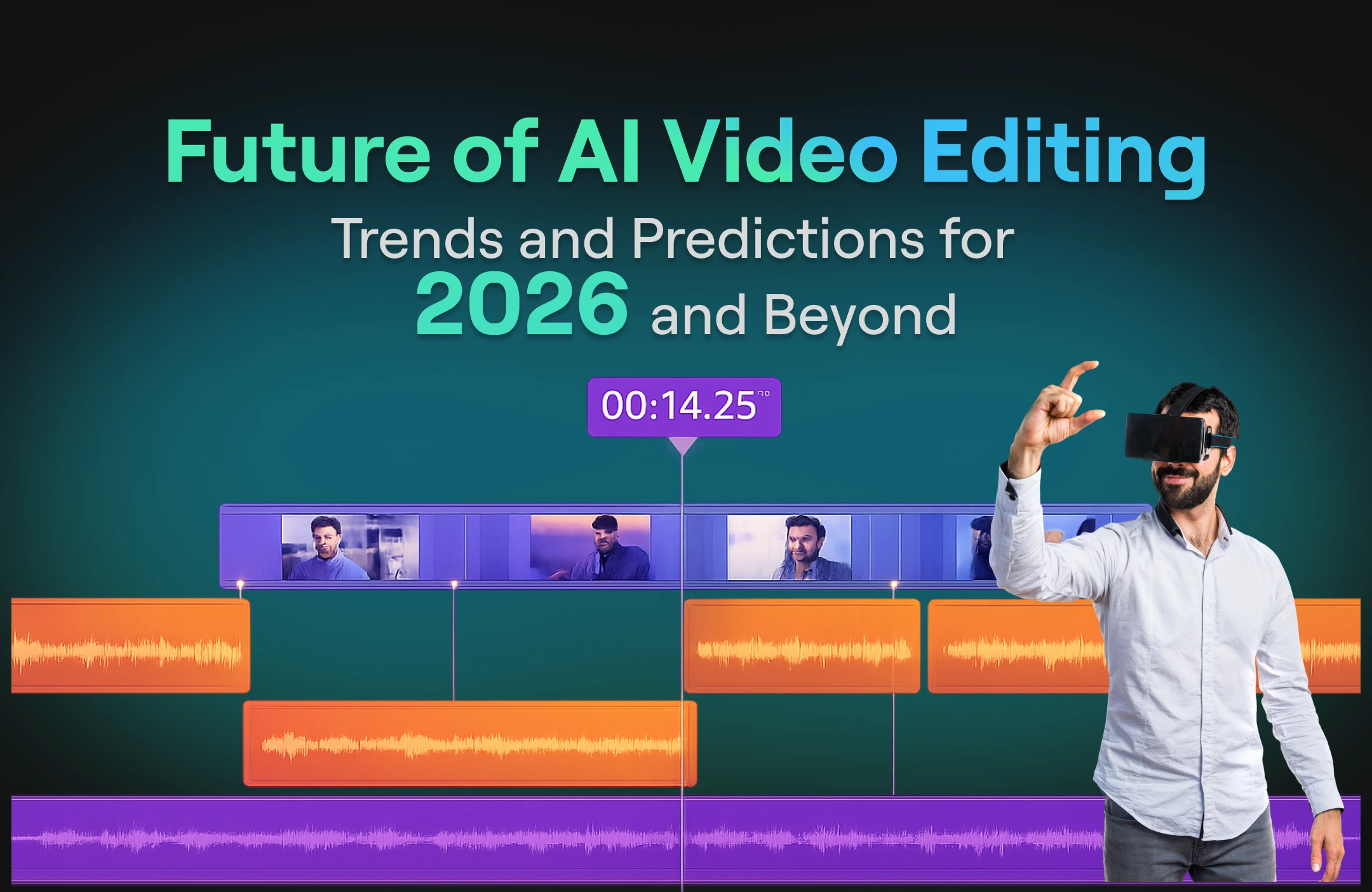
Future of AI Video Editing: Trends and Predictions for 2026 and Beyond

SameedProduct Manager
Key Takeaways
- This gap defines the next phase of AI video editing
- Instead of responding only to prompts or timelines, future AI editors will increasingly infer:
- Today’s AI clipping tools identify moments after the fact
- They analyze what was said and select segments that appear important
- By 2026, clipping systems are likely to become predictive
- Captions are already essential for accessibility and sound-off viewing
AI video editing has moved fast over the last few years, but most of what we see today is still early-stage automation. Tools clip videos faster, generate captions more accurately, and reformat content for different platforms but they largely react to instructions rather than understand intent.
As we look toward 2026 and beyond, the biggest shift won’t be incremental feature improvements. It will be a structural change in how video editing systems understand content, performance, and distribution.
This article takes an analytical look at where AI video editing is heading next, based on observable trends in creator behavior, platform incentives, and current limitations in today’s tools. Rather than predicting sci-fi outcomes, we’ll focus on what is already emerging and how it’s likely to evolve.
AI Video Editing Is Still in Its First Phase
Despite how powerful modern tools appear, most AI video editing systems today operate in a narrow scope. They optimize for speed and automation, but not for outcomes.
Current tools are good at:
- Detecting speech
- Cutting clips based on silence or speaker changes
- Generating captions
- Reformatting aspect ratios
What they struggle with is understanding why a moment matters, who it’s for, and how it will perform on a specific platform.
This gap defines the next phase of AI video editing.
From Editing Tools to Context-Aware Systems
One of the most visible shifts heading into 2026 is the transition from AI as an assistant to AI as a context-aware system.
Instead of responding only to prompts or timelines, future AI editors will increasingly infer:
- Topic relevance
- Emotional emphasis
- Conversational peaks
- Viewer intent
- Platform expectations
This doesn’t mean full creative autonomy. It means systems that can make informed suggestions based on patterns across thousands or millions of videos.
The data already exists. Platforms track watch time, replays, drop-off points, and engagement signals at a granular level. AI editing systems are beginning to close the loop between content structure and performance outcomes.
Clipping Becomes Predictive, Not Reactive
Today’s AI clipping tools identify moments after the fact. They analyze what was said and select segments that appear important.
By 2026, clipping systems are likely to become predictive.
This means:
- Identifying moments likely to perform well before publishing
- Prioritizing clips based on historical engagement patterns
- Adjusting clip length and pacing based on platform-specific behavior
For example, the same long video may produce different “best” clips for TikTok versus YouTube Shorts not because of format, but because of audience behavior. This shift is driven by one key reality: volume alone no longer guarantees reach. Platforms increasingly reward predictable engagement, not just frequency. This direction is most visible in tools designed specifically for short-form content, where one long video can already be repurposed into multiple platform-ready clips.
Captions Become the Primary Interface Layer
Captions are already essential for accessibility and sound-off viewing. But their role is expanding.
In the coming years, captions will act less like subtitles and more like an interface layer that guides attention. This includes:
- Dynamic emphasis on keywords
- Timing that shapes pacing
- Platform-adapted styles
- Contextual cues for tone or transitions
Rather than being a static overlay, captions will increasingly control how information is consumed visually. This trend aligns with how users actually engage with short-form video: scanning, skimming, and reacting quickly. Text becomes the anchor point, not the audio. As captions take on a more active role, understanding how different caption formats affect performance becomes increasingly important.
Multilingual Editing Becomes Default, Not Optional
Global distribution is no longer limited to large media companies. Creators and businesses increasingly reach international audiences without planning to.
As a result, multilingual capabilities will move from “advanced feature” to baseline expectation.
By 2026:
- Automatic translation will be assumed
- Dubbing and captions will coexist
- Language targeting will become part of publishing workflows
This isn’t about perfection in translation it’s about reach. AI systems already outperform manual workflows in speed and consistency, and that gap will continue to widen. This shift is already visible in how creators use captions and translations to reach global audiences without creating separate videos for each language.
Vertical-First Thinking Replaces Format Conversion
Currently, creators still think in terms of formats: horizontal vs vertical, long vs short.
That distinction is slowly disappearing.
Future AI video editors will treat video as a single source that adapts automatically to:
- Device orientation
- Platform layout
- Viewing context
Instead of converting formats, systems will generate outputs dynamically. A clip won’t be “cropped” for vertical, it will be designed for it. This aligns with how platforms evolve. TikTok, Reels, and Shorts are not simply vertical video platforms; they are attention systems optimized for mobile behavior.
Performance Feedback Loops Shape Editing Decisions
One of the most important shifts ahead is the integration of performance feedback into editing logic.
Rather than editing being a one-time step, AI systems will increasingly:
- Learn from how clips perform
- Adjust future outputs automatically
- Optimize pacing, length, and structure over time
This doesn’t mean chasing virality blindly. It means learning what consistently works for a specific creator, brand, or niche.
Editing becomes iterative, not static.
Personalization Without Fragmentation
Personalized video is often misunderstood as creating entirely different videos for different audiences. That approach doesn’t scale.
What will scale is modular personalization:
- Different hooks for different platforms
- Caption emphasis based on audience familiarity
- Context-aware intros and outros
AI video editing systems are well suited for this because they operate on components rather than fixed timelines. By 2026, personalization will be subtle, systematic, and automated not manual or experimental. This approach is especially relevant for creators producing testimonial-style or educational content, where the same message must resonate with different audiences.
What This Means for Creators
Creators who succeed in the next phase of AI video editing will not necessarily be the most technically skilled. They’ll be the most system-oriented.
This means:
- Thinking in workflows, not individual videos
- Designing content for reuse
- Letting AI handle repetition
- Focusing human effort on ideation and storytelling
The creators who resist automation often cite quality concerns. In practice, the opposite tends to happen: consistent systems produce more consistent results.
What This Means for Brands and Businesses
For brands, AI video editing is moving from cost-saving tool to strategic asset.
As platforms become more competitive, the ability to:
- Repurpose content quickly
- Adapt messaging across channels
- Maintain consistent output
…will increasingly define marketing effectiveness. Businesses that rely on one-off, manual editing processes will struggle to keep up with teams using AI-driven workflows.
What This Means for the Industry
AI video editing is not replacing editors. It is redefining what editing means. Manual timelines will still exist but they won’t be the bottleneck. Strategy, content selection, and performance analysis will matter more than technical execution.
The industry is moving toward systems that combine:
- Automation
- Context awareness
- Performance insight
- Scalable workflows
This shift mirrors what happened in other creative industries, from design to writing to analytics.
The Next Phase Is About Systems, Not Features
Looking ahead to 2026 and beyond, the biggest change in AI video editing won’t be a single breakthrough feature. It will be the emergence of end-to-end systems that connect content creation, editing, distribution, and performance.
The tools that succeed will be those that:
- Understand context
- Adapt to platforms
- Learn from outcomes
- Scale with creators and businesses
AI video editing is no longer about doing the same work faster. It’s about enabling workflows that weren’t practical before. And as those systems mature, the advantage will go to those who adopt them early, understand their limits, and use them intentionally.
Curious how these trends are already taking shape today? Explore how creators are using modern AI clipping tools to repurpose long videos into short-form content.
reap functions as a complete AI video editor and repurposing platform. It automatically generates subtitles, supports branded templates, offers AI voice dubbing and transcript‑based editing to remove filler words, and reframes for different aspect ratios. With multi‑language captions and built‑in scheduling, Reap consolidates tools like reels maker, dubbers and voice‑cloning software into one simple workflow.
Frequently Asked Questions
The future of AI video editing in 2026 is moving beyond basic automation toward context-aware systems that understand content, audience intent, platform behavior, and performance signals. Instead of only speeding up editing, the next generation of AI tools will help creators make smarter editing decisions.
Yes. AI video editing tools are expected to become more context-aware by identifying topic relevance, emotional emphasis, conversational peaks, viewer intent, and platform-specific expectations. This helps move AI from simple automation toward more intelligent editing support.
AI clipping tools are likely to become more predictive in 2026. Instead of only selecting important moments after analysis, they will increasingly prioritize clips based on likely performance, historical engagement patterns, and platform-specific behavior.
Yes. Multilingual editing is expected to become a default part of AI video workflows, with caption translation, dubbing, and language-targeted publishing becoming more common for creators and brands reaching global audiences.
No. AI video editing is more likely to redefine editing than replace editors entirely. Automation will handle repetitive production tasks, while humans will remain important for storytelling, strategy, creative judgment, and content direction.
Last Updated:
January 28, 2026