Most people use the words subtitles and closed captions as if they mean the same thing. They don’t. And on social media, confusing the two quietly costs creators, brands, and businesses a huge amount of watch time, engagement, and conversions.
If you’ve ever uploaded a video thinking, “I added subtitles, so I’m good,” but still saw low retention or weak performance, this is probably why. Viewers today consume content differently than they did even a few years ago. They scroll faster, watch silently more often, and decide whether to stay or leave within seconds. In that environment, the difference between subtitles and closed captions isn’t semantic, it’s performance-critical.
This blog breaks down what subtitles and closed captions actually are, how they behave on social platforms, and which one truly works for short-form video. More importantly, it explains why captions win, not just from an accessibility standpoint, but from a psychological and algorithmic one.
Why This Confusion Matters More Than Ever
Short-form video is now the default format for discovery. TikTok, Instagram Reels, YouTube Shorts, LinkedIn video, and even Facebook feeds all reward content that keeps people watching. The algorithm doesn’t care how good your message is if viewers don’t stay long enough to hear it.
At the same time, sound-off viewing has become the norm. People watch videos in public, at work, late at night, or while multitasking. In many cases, captions are the only way your message is understood.
This is where many creators and brands go wrong. They assume any text on screen equals captions. But subtitles and closed captions serve different purposes, behave differently across platforms, and influence viewer behavior in very different ways.
What Are Subtitles, Really?
Subtitles were originally designed for translation. Their primary job is to help someone understand spoken dialogue when the language is unfamiliar. Because of that, subtitles focus almost entirely on words, not context.
Subtitles usually assume the viewer can hear the audio. They don’t describe tone, emotion, background sounds, pauses, or emphasis. They’re often optional, minimal, and designed to be turned on or off.
On platforms like YouTube, Netflix, or long-form video players, subtitles make sense. They’re clean, unobtrusive, and serve a specific purpose: language comprehension. But social media is not a movie theater. It’s a scrolling battlefield for attention.
What Are Closed Captions And Why They’re Different
Closed captions are designed for comprehension without sound. They don’t just show what is being said; they help the viewer understand the full context of the video.
Closed captions often include tone indicators, pacing, emphasis, and even non-verbal cues. More importantly for social media, they are integrated into the viewing experience, not optional extras hidden behind a settings button.
On short-form platforms, closed captions aren’t just accessibility tools. They are attention tools.
They guide the eye.
They reinforce meaning.
They highlight key ideas.
They shape how the video is consumed.
This is why high-performing social content almost always uses caption styles that feel designed, not passive.
How People Actually Watch Videos on Social Media
Understanding viewer behavior explains why captions outperform subtitles so consistently.
Most people don’t “watch” social videos in a traditional sense. They scan. They skim. They scroll. Their thumb is always ready to move.
When a video starts, the viewer subconsciously asks three questions in under two seconds:
What is this about?
Is it relevant to me?
Is it worth my time?
Closed captions answer those questions immediately. Subtitles usually don’t. Because subtitles are often small, static, and optional, they don’t stop the scroll. Closed captions, when done well, act like visual hooks. They pull the viewer into the message even before the audio kicks in. This is why creators who rely on subtitles often feel like their videos “should” perform better, but don’t.
Where Subtitles Work And Where They Fail
Subtitles still have a place. They work well in long-form content, interviews, documentaries, podcasts, and educational videos where the viewer is already committed to watching.
But on social media, subtitles struggle because they:
- Assume sound is on
- Don’t guide attention
- Don’t emphasize key points
- Don’t visually anchor the message
- Don’t help with pacing
- Don’t enhance retention
Subtitles are passive. Social media requires active visual storytelling. This mismatch is why so many well-produced videos fail to gain traction despite having “text” on screen.
Why Closed Captions Perform Better on TikTok, Reels, and Shorts
Closed captions are built for the way social platforms work.
They are readable at a glance.
They appear immediately.
They move with the video.
They emphasize the right words.
They match the speaker’s rhythm.
More importantly, they keep people watching longer.
Platforms measure watch time, completion rate, and replays. Captioned videos consistently outperform non-captioned or subtitle-only videos across all of these metrics. The reason is simple: captions reduce cognitive load. The viewer doesn’t have to work to understand what’s happening. The message comes to them. This is especially important in fast-paced formats like UGC, tutorials, testimonials, comedy clips, and educational content.
Captions, Accessibility, and Algorithms
Accessibility is often framed as a compliance issue, but on social media it’s a growth advantage.
Closed captions make content accessible to:
- Deaf and hard-of-hearing viewers
- Non-native speakers
- Viewers watching without sound
- People in noisy environments
- People with attention challenges
Platforms reward this. Content that is easier to consume by more people naturally performs better. In other words, captions don’t just help users they help algorithms understand that your content is engaging a wider audience. This is one of the quiet reasons captioned videos are more likely to be pushed further.
Why “Just Adding Subtitles” Isn’t Enough Anymore
Many creators and brands still rely on auto-generated subtitles from native apps. These often look fine at first glance, but they fall short in key ways.
They’re slow to appear.
They’re poorly timed.
They’re visually dull.
They don’t emphasize meaning.
They don’t match brand style.
On competitive feeds, this is the difference between being watched and being ignored. Closed captions for social media need to be intentional. They should feel like part of the content, not an afterthought.
How Reap Approaches Captions Differently
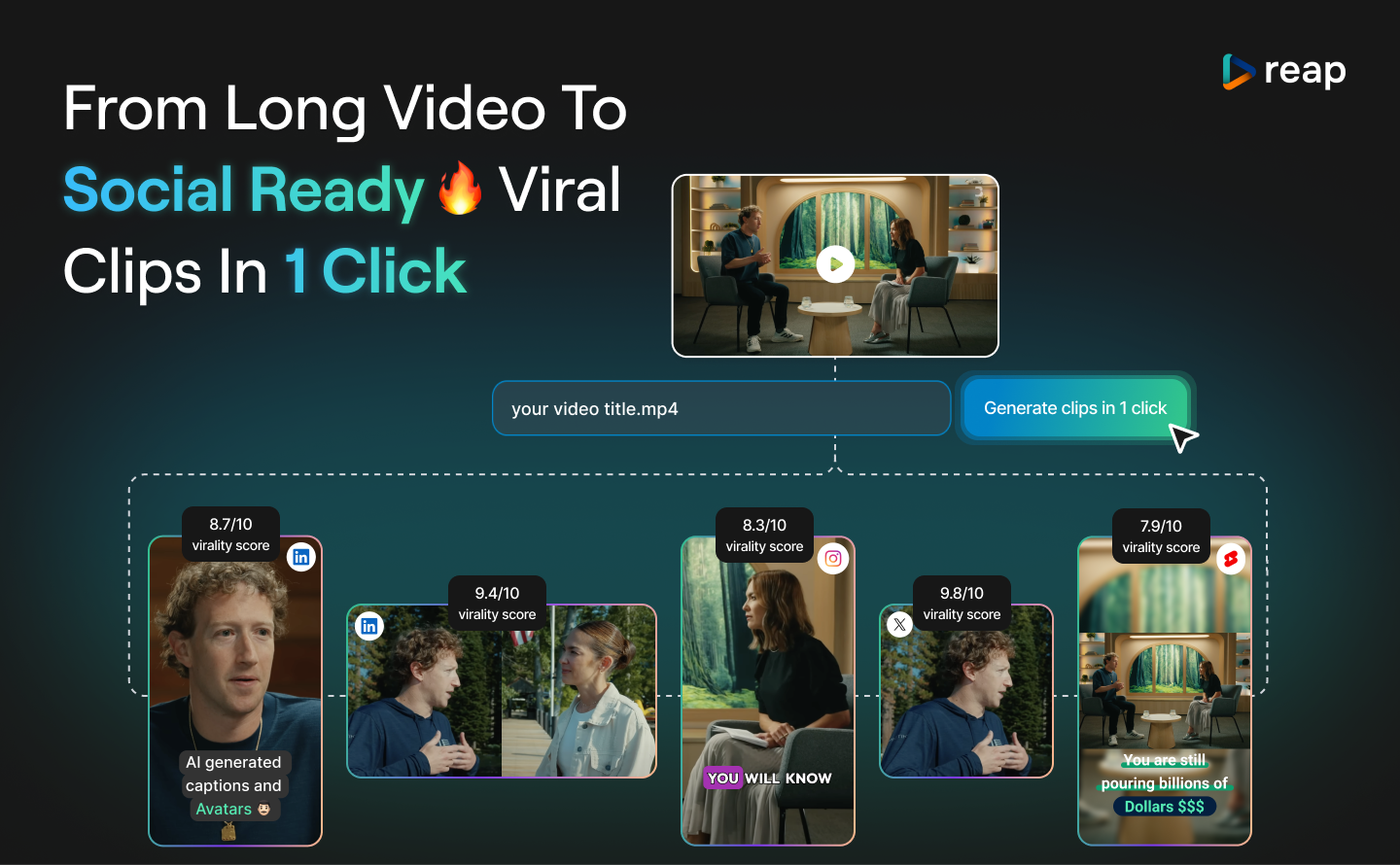
Reap treats captions as performance elements, not just transcripts. Instead of dumping text on screen, Reap generates captions that follow speech patterns naturally, appear exactly when they’re needed, and visually reinforce the message. Keywords are highlighted. Timing feels human. Pacing matches delivery.
For creators, this means captions that feel hand-edited without spending hours editing.
For brands, it means content that looks polished and ready for distribution.
For businesses, it means higher retention and clearer messaging.
This approach bridges the gap between accessibility and marketing, which is exactly where social video lives today.
Real-World Use Cases Where Closed Captions Win
Creators who rely on fast communication like UGC creators, educators, coaches, and comedians, benefit the most from closed captions. Their content depends on clarity, timing, and emotional delivery.
Testimonial videos perform better when captions emphasize transformation moments.
UGC ads convert better when benefits are visually reinforced.
Educational clips retain more viewers when steps are readable.
Comedy clips land harder when punchlines are captioned with precision.
In all of these cases, subtitles alone aren’t enough. Captions guide the experience.
Subtitles vs Closed Captions: The Real Answer
So which one actually works on social media?
| Aspect | Subtitles | Closed Captions |
|---|---|---|
| Primary purpose | Translate spoken words | Communicate full meaning without sound |
| Designed for | Language understanding | Sound-off viewing and accessibility |
| Best suited for | Long-form videos, movies, interviews | Short-form social content |
| Includes tone & emphasis | ❌ No | ✅ Yes |
| Optimized for scrolling feeds | ❌ No | ✅ Yes |
| Appears immediately on video | ❌ Often optional | ✅ Always visible |
| Guides viewer attention | ❌ Minimal | ✅ Strong visual guidance |
| Improves watch time | ⚠️ Limited | ✅ Significant |
| Works well without audio | ❌ No | ✅ Yes |
| Boosts engagement & retention | ⚠️ Sometimes | ✅ Consistently |
| Ideal for TikTok, Reels & Shorts | ❌ No | ✅ Yes |
| Supports accessibility | ⚠️ Partially | ✅ Fully |
| Best for conversions | ❌ Weak | ✅ Strong |
If your goal is reach, retention, and results, closed captions consistently outperform subtitles on short-form video.
Captions Aren’t Optional Anymore
On social media, captions are no longer a technical detail. They are part of the storytelling. Creators who rely on subtitles alone leave performance on the table. Brands that skip proper captions lose attention. Businesses that treat captions as optional struggle to compete.
Closed captions don’t just make videos accessible, they make them effective.
If your goal is to be understood, watched, and remembered on modern platforms, captions aren’t something you add at the end. They’re something you design from the start. And in today’s feeds, the difference between subtitles and closed captions is often the difference between being seen and being skipped.
Try Reap and add captions to your videos free.
Reap functions as a complete AI video editor and repurposing platform. It automatically generates subtitles, supports branded templates, offers AI voice dubbing and transcript‑based editing to remove filler words, and reframes for different aspect ratios. With multi‑language captions and built‑in scheduling, Reap consolidates tools like reels maker, dubbers and voice‑cloning software into one simple workflow.